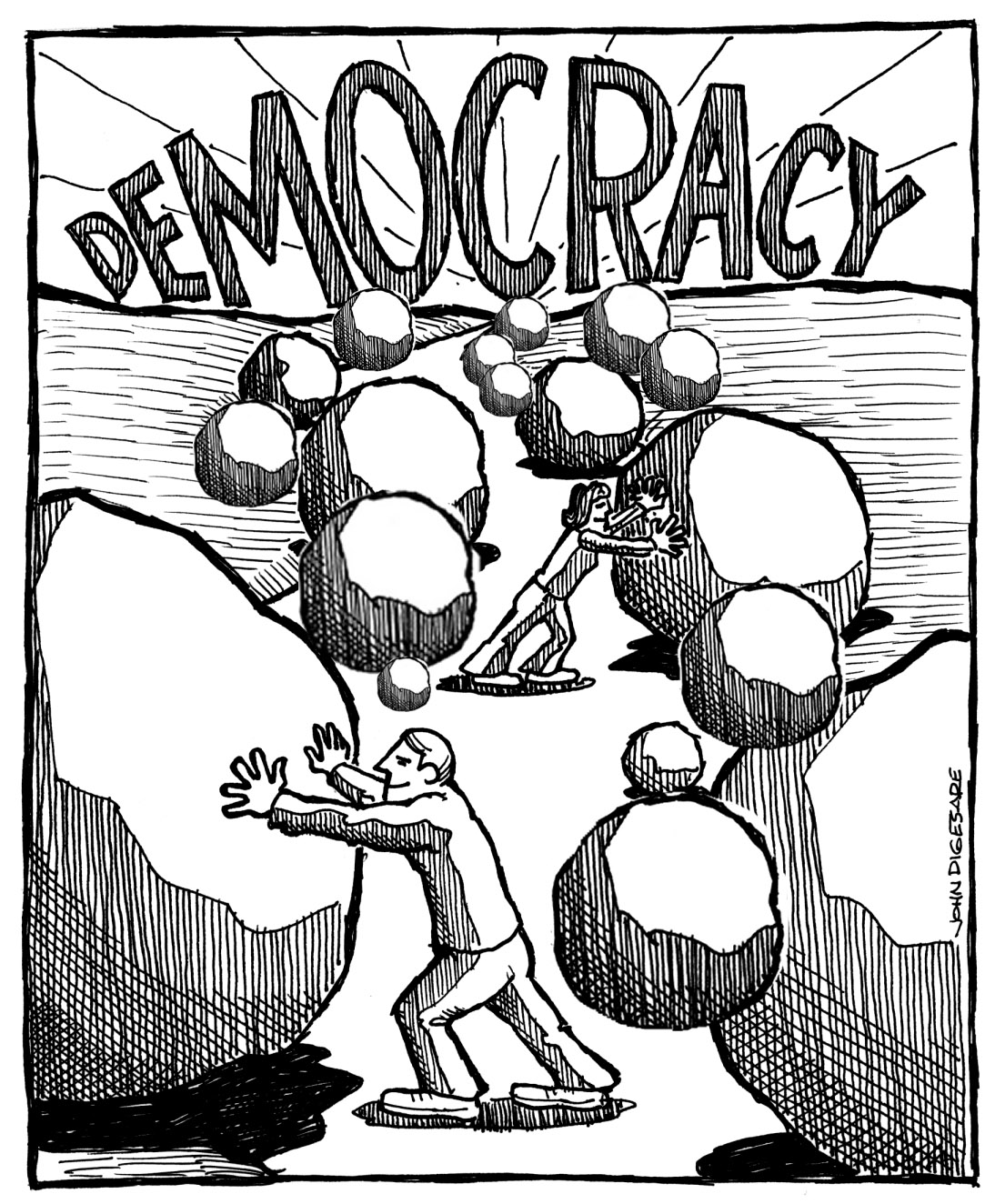
Judges and the judicial system play a huge role in supporting freedom. The judicial branch is mainly in charge of interpreting the law and applying it in society, therefore they hold a large influence in government. Without the law, the country would be very chaotic because everyone would be able to do as they please. They support freedom by establishing certain laws which define what is acceptable in a free society. It is an excellent idea in any nation to have established what is acceptable and what is not acceptable in order to avoid complete chaos because every single person's perspective on what is wrong or right will differ. It is impossible to have a country where all of the people will agree on the same thing. Judicial Activism plays a very large role in supporting freedom because it allows the courts to "overrule laws made by a majority of elected officials" (The Power of Politics, p. 264). This concept has been viewed as a way for "judges [to protect] the weak from oppressive majorities" (The Power of Politics, p. 264). This conveys the power of the judicial branch and importance that it plays in keeping the other two branches honest.
I really like this cartoon because it emphasizes the downside of law, which may occur if the law is taken too far. Sometimes the law may contradict the freedom of choice. For example legally people are required to wear seat belts when they drive for their own protection. That makes me think though, shouldn't my safety be a choice that I make instead of having made for me. Another topic that has been very controversial is the freedom of smoking. It has always been a topic of whether or not smoking should be made illegal because of the negative health effects that it causes. Personally I do not smoke because I hate the smell and the negative health effects, however it should be my own choice. I thought that this cartoon went really nicely with this topic because it shows that if there are too many things which are not allowed, then there is nothing left.
References:
The Politics of Power. Ira Katznelson, Mark Kesselman, Alan Draper. 2011
Cartoon: <https://blogger.googleusercontent.com/img/b/R29vZ2xl/AVvXsEiYnhHCX6syZP9TgRzTcZUkIkbVnJ3Y4Zoc08pooR5ex5JqBg7ySNkk46gfNhV0YkjSMuhCRP9dXQGVqmeRtBTBK6KWkkkc-DJpoRmiR429epKqLlUkdz1HrqVmwWIo2oUDbMCzRvP794Q/s400/cartoon_fridge+04-02-04.jpg>
Sunday, March 20, 2011
Sunday, March 13, 2011
How does the U.S. Congress, as it exists in its current structure, support and/or limit authentic representation?
Congress is in large part responsible for financial decisions. The political process and the bureaucracy that is common within Congress limits productivity. That is why there is a disconnect between what the general public desires and what Congress prioritizes. Those issues that are minor, such as, naming Acts/Bills, and advertisement noise laws, are passed by Congress much more expeditiously, that bills that would actually benefit society. In my opinion, Congress needs to focus on the real issues first and not waste time on unnecessary issues such as how a bill should be named.
Even though the representatives are elected, they hardly represent the opinion of the people. In politics it is not unusual for opinions and ideas to differ before and after the election is over with. Congress is a very important part of government due to their "substantial responsibilities" (The Power of Politics, p. 210) including the capacity to declare war, to collect taxes, to regulate commerce, etc. Congress also limits authentic representation due to lobbyists. Elections are greatly influenced by special interest groups who offer to provide campaign funding. As the book mentions, "those with the most political resources outside of Congress are in the best position to take advantage of Congress's accessibility to cultivate relationships" (The Power of Politics, p. 239) with the various members. As the cartoon illustrates lobbying influence increases rapidly year after year. Lobbying increased by $1.9 billion, in the time period of 10 years (The Power of Politics, p. 239)
References:
Cartoon: <http://www.michellehenry.fr/lobby6.jpg>
"The Politics of Power"- Ira Katznelson, Mark Kesselman, Alan Draper.
![]() |
| Obtained From: <http://www.michellehenry.fr/lobby6.jpg> |
Even though the representatives are elected, they hardly represent the opinion of the people. In politics it is not unusual for opinions and ideas to differ before and after the election is over with. Congress is a very important part of government due to their "substantial responsibilities" (The Power of Politics, p. 210) including the capacity to declare war, to collect taxes, to regulate commerce, etc. Congress also limits authentic representation due to lobbyists. Elections are greatly influenced by special interest groups who offer to provide campaign funding. As the book mentions, "those with the most political resources outside of Congress are in the best position to take advantage of Congress's accessibility to cultivate relationships" (The Power of Politics, p. 239) with the various members. As the cartoon illustrates lobbying influence increases rapidly year after year. Lobbying increased by $1.9 billion, in the time period of 10 years (The Power of Politics, p. 239)
References:
Cartoon: <http://www.michellehenry.fr/lobby6.jpg>
"The Politics of Power"- Ira Katznelson, Mark Kesselman, Alan Draper.
Sunday, March 6, 2011
In what ways does the U.S. Presidency support and limit the formation of an ideal democracy?
In order to be ideal, a democracy needs to be perfectly structured without flaws in the system. That seems to be out of reach in real life because nothing is ever ideal. The U.S. presidency limits the formation of an ideal democracy because all some people have conflicting ideas and opinions. A democracy means for the people by the people, however there is no way that all of the people in the U.S. can agree on one thing and have the same opinions on issues. One of the concerns that came up after the Revolutionary War in 1776 was that "it did not provide for a single official responsible for directing the executive branch who would be independent of Congress (The politics of power, p.175). I like this cartoon because it represents all of the issues that block any country from reaching an ideal democracy. The importance of the presidency was greatly established due to the fact that without a president the "government could otherwise drift and be stalemated in a system of checks and balances" (The politics of power, p. 178).
Subscribe to:
Posts (Atom)