Sunday, February 27, 2011

How do individuals and groups of people influence the political process?

Individuals and groups of people influence the political process very differently.   Individuals have influence when they vote. When an individual is making a decision on who to vote for, they mostly can rely on their own ideas and opinions to lead them in the right direction. When people are part of a group, they tend to lose their own opinion and sometimes go along with somebody else. It is important for people to retain their individuality when voting because that is the only way that they will be represented according to their own ideas and principles.  Groups of people tend to gather when it comes to having a common goal achieved, such as environmentalists.  Political candidates will try to appeal to these large groups of people by presenting ideas and goals that appeal to those groups.  As the book mentions, the "environmental movement [has become] more theoretically and politically diverse" (The Politics of Power, p.166).  When it comes to the environment more and more people become involved everyday because they realize the importance of the preservation of our environment.  The book also mentions that in the beginning of the twentieth century there were two groups of environmentalists: conservationists and preservationists.  Later on the two "joined together to oppose reckless abuse of the land and its resources" (The Politics of Power, p.164).  The environmentalist compose a very large group in today's day and they hold a lot of voting power.  This is why when elections are held, politicians try to appeal to the environmentalists by providing the public with their own ideas and goals in regards to the environment. 


Obtained from: <http://www.cagle.com/news/EnvironmentMadden/environmentCartoonGIFS/tree%20of%20life%20chainsaw.gif>


 When we examine the situation in Egypt, we can see the power of large groups of people.  Many people there were dissatisfied with the government that they had. This is why they decided to come together to have their voice be heard. When the majority is dissatisfied with the political process, they have the power to influence who takes part in political leadership and how the political process runs. In Egypt, the president stepped down as a result of the people's dissatisfaction with the political leadership. An article on CNN mentions that the social site facebook also played a part in the stepping down of the president, due to many political groups that organized via the Internet in order to make their protests heard (Egyptian president steps down amidst groundbreaking digital revolution).

Sources:
"The Politics of Power," - Ira Katznelson, Mark Kesselman, Alan Draper
"Egyptian President Steps Down Amidst Groundbreaking Digital Revolution" -
<http://articles.cnn.com/2011-02-11/tech/egyptian.president.digital.mashable_1_social-media-cnn-moment-english-language-network?_s=PM:TECH>
Cartoon -  <http://www.cagle.com/news/EnvironmentMadden/environmentCartoonGIFS/tree%20of%20life%20chainsaw.gif>
Sunday, February 20, 2011

In what ways does public opinion influence the formation of a democratic society?

Public opinion has great influence on the formation of a democratic society.  A democratic society means that the government is for the people by the people.  This definition implies that the public participates a great deal in politics.  Unfortunately that is not always true because some people choose not to vote during elections and that means that their ideas and opinions may not be represented after the representatives are elected.  The public votes in order to choose a representatives who will provide a reflection of their own ideas and opinions, and that way they can make themselves heard when it comes to politics.  I thought this cartoon was kind of funny since it's tax season and we're all excited to get some money back even though we paid it in first place. 


Obtained From: <http://www.frugal-cafe.com/public_html/frugal-blog/frugal-cafe-blogzone/wp-content/uploads/2009/03/op-ed-comic-prez-tax-plan1.jpg>

Sunday, February 13, 2011

How Does the Governement Intersect With the Private Sector

 The government and the private sector intersect in many ways.  The economy and the government pretty much go together.  The government has to regulate the private sector in order to avoid large corporations taking advantage of people.  If the government did not regulate companies at all it would result in many employees being treated poorly and making incredibly low wages and in return the corporations would profit quite a bit.  Another thing that has to be regulated by the government would be the working conditions within the large corporations.  This is both for the employees and the public's well being.  For example meat packing plants need to be regulated in order to avoid certain health risks.  Another result of lack of regulation would be exploitation of child labor.


As the book explains throughout time workers , farmers and environmentalists challenged "business successfully and required the government to adopt policies that regulate markets" (the politics of power, p.66).  This is due to the fact that corporations were exchanging the well being of the environment and workers for a larger amount of profit.  The book also demonstrates that the government has had a hand in economic expansion for a long time.  One example of this is railroads, which contributed a major boost to the economy at the time.  This would not have been done without the government as a contributing party to the development of the railroads (the politics of power, p.67). Unemployment is really affecting the economy at the moment reaching heights of "over nine percent unemployment" (Newt Gingrich, former speaker of the house).  With the help of the government unemployment rates can hopefully be reduced by creating jobs, and therefore improving the economy (Fox News).

References:

"The Politics of Power"- Ira Katznelson, Mark Kesselman, Alan Draper.
On the Issues at CPAC: Jobs and the Economy <http://politics.blogs.foxnews.com/2011/02/11/issues-cpac-jobs-and-economy>


Sunday, February 6, 2011

Role of Power in Government, Economy, and Politics

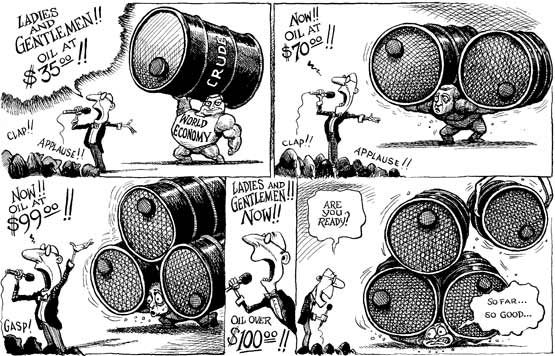
Power usually plays a huge role in government, economy, and politics.  The power in politics usually means the power of influence.  Lately in the news the rising of energy prices has been a prevalent topic.  The scarcity of oil means power for the countries in the greatest possession of oil.  The consumption of oil unfortunately exceeds the production and therefore represents a threat to the economy of the United States in the future.  When talking about Egypt's effect on oil price increases Fortune Magazine delineates that  "what really stands to tighten the screws on oil fiends is the rising demand for that shrinking supply" (http://finance.fortune.cnn.com/2011/01/31/how-egypt-spells-oil-spike/).  In the near future therefore those who have the power of energy will also have the power to set the prices as high as they wish.  In the book it is discussed that the power in government is directly tied to the power of the economy.  If the power lies with the government then corporations' treatment of employees improves, if the power lies with the corporations they tend to control a great amount of power.  The government has to control certain aspects because "unless business firms are required to pay the costs of doing business, they will avoid doing so" (p. 29).  The book also talks about the way companies are generally interested in making a profit rather than the well being of society.  As examples the book talks about pharmaceutical companies and mortgage companies.  These two examples really portray the need of people for shelter and medicine versus the need of companies to make profits.  The power lies in the companies though so the people who need the help are unfortunately out of luck.  
Obtained from: <http://fortunewallstreet.files.wordpress.com/2011/01/egypt.gif>
Obtained from:
<http://static.seekingalpha.com/uploads/2009/1/5/saupload_07_11_25_economist_cartoon.jpg>

References: "The Politics of Power"- Ira Katznelson, Mark Kesselman, Alan Draper.
"How Egypt Spells Oil Spike" - <http://finance.fortune.cnn.com/2011/01/31/how-egypt-spells-oil-spike/>
Chart - <http://fortunewallstreet.files.wordpress.com/2011/01/egypt.gif>
Cartoon - <http://static.seekingalpha.com/uploads/2009/1/5/saupload_07_11_25_economist_cartoon.jpg>